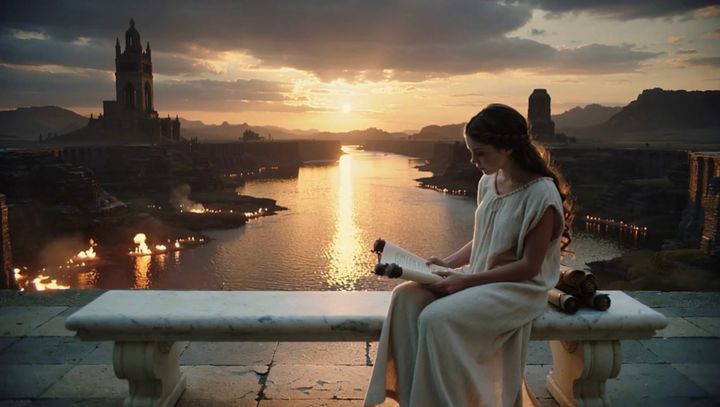
Hades always felt empty after Persephone saw the returning souls off into the world. To allay her sadness, she went to the Hall of Scrolls, to reread what the Moirae had in store for them.
Hades’s palace was vast, and not many people knew that, because very few had been allowed past the sumptuous rooms at the front, which were intended for receiving visitors.
It had libraries and vaults, salons and dining halls, and since his marriage with Persephone, interior gardens.
Since Hades didn’t have weather, half of the spaces were open to the outdoors, facing colonnades and atria, fountains of living waters and magical trees.
Everything had spirit in the Underworld, and Persephone often lost track of time talking to the trees in the open courtyards, or the flowers in her daffodil garden.
The latter was a gift from Hades, who worried she might miss the meadows of her maiden days, a garden bursting with daffodils perpetually in bloom.
The palace was constantly morphing, adding and removing rooms, and there was always a surprise somewhere, just when one thought they’d mapped it all out, but Hades made sure Persephone’s favorite places remained untouched, so she could maintain them as she saw fit.
She walked past the marble fountain at the entrance of the Hall of Scrolls, whose shallow basin doubled as a reflecting pool, into the main room, so large she could barely make up its intricate ceilings, and where every sound reverberated echoes into infinity.
The scrolls were stored in stark ebony cabinets, lining up on the column lines, and all the aisles between them ended at balconies which had built-in marble benches and offered a breathtaking view of the river Phlegethon.
No one ever went there, because, Persephone mused, nobody, neither the mortals, nor the gods, wanted to be reminded their fates were set in stone. What was the purpose of any activity if one was like a marble moving in a groove impossible to escape?
It didn’t bother Persephone much, first, because her groove was a privileged one, and second because after the dreadful powerplay between her husband and her mother, in which other people had decided her fate, she had already been disabused of the notion she had a say in her own life.
She just couldn’t help the thought that at least the mortals and the gods had the illusion of control, which for the Moirae, who saw everything and knew every outcome, was impossible to maintain, a rather questionable privilege which made their awesome power feel more like a curse.
The three had been spinning the fates of beings for all eternity, and had no hope for personal aspirations or dreams of their own. They were prisoners of their own device, bound by Fate as well, before everyone else.
Her own scroll was in there somewhere, and nothing prevented her from reading it, if she wanted to, but she didn’t.
What would she find in it that she didn’t already know, other than potentially unwelcome surprises?
The gods were supposed to enjoy their extraordinary privileges free from suffering, so the Moirae, bitter over being unfairly bound to their task, often intertwined their lives with those of the humans, to sneak death and loss into them by proxy, quite the spiteful passive aggressive move, Persephone thought.
Even more so since the gods endured for all eternity, and therefore were not given a fresh start by drinking the waters of the Lethe, so every loss and every hurt would last them forever.
As she was strolling through the isles, all looking exactly the same, she realized she couldn’t remember were the scrolls of the two thousand were, and the delicious irony of the situation presented itself in all its glory: what good did it do one to know the information was available if one forgot where one put it?
She had stored those scrolls all by herself, upon arriving in the fall, and therefore she couldn’t ask anyone else for help in finding them, and it just dawned on her that this, this precise moment, was the existence sized practical joke Fate played on all creation, finding ever more innovative ways of preventing beings from learning what they were not destined to know.
Even her memory of what was in those scrolls had started to fade, though she had studied them dutifully at the time, to make sure her charges were getting a fair share.
Come to think of it, she wasn’t even sure there was a reality outside the boundaries of her knowledge, maybe things got rendered in real time, from nothing, like the figments from the Land of Dreams, to reflect her discoveries, her feelings and her thoughts, and existence was a much larger version of Hades’s palace, where new rooms continuously created themselves.
‘Ah! There!’ She thought, triumphant, when she recognized the aisle where she had placed the scrolls, which the Fates had decided to reveal to her after all.
After long years of getting frustrated by this game of hide and seek, where things appeared and disappeared, were surprisingly found in places they shouldn’t have been, or simply slipped out of one’s mind like they had never existed, only to pop up in glaring clarity decades later, Persephone had abandoned any expectation of certainty and was living in the present, taking as a given only whatever was unfolding in front of her eyes at the time, and taking nothing for granted.
Of course one couldn’t plan anything under such circumstances, but what was there to plan if the Moirae could delete and restore even her memories as they pleased, adding and removing things from her reality on a whim?
Persephone was a tragic decorative goldfish, who had just gleaned the knowledge she was living in a fishbowl, in a substance called water, for all the good that knowledge did her.
So she grabbed a few scrolls and made herself comfortable on one of the marble benches to study them, but was soon distracted by the droning nature of human fate.
She rested her eyes on the flaming waters of the Phlegethon, watching their gemstone banks sparkle in the perpetual sunset, and a horrible thought dawned on her.
What if her life with Hades was just another fixture in that fishbowl, one that the Fates had placed there for their own purpose, which she would never glean, and her own feelings for him had been installed by the latter as well, to facilitate the smooth workings of their plans.
If she couldn’t control her own memories, or what was going to happen next, what made her take her feelings for granted, if there was such a thing, or even the fact Hades existed when he was out of her sight?
And if there was any truth to this realization, what did it mean to be in this context?
And how did the intricate web of relationships, affinities and ambitions continue to unfold with such convincing precision, how did any action and thought maintain coherence and continuity when any part of this makeshift reality could be removed, rebuilt or refashioned to mean its exact opposite in the blink of an eye?
You can’t assert nothing is real while taking in reality through your senses.
Nothing is what you thought, nothing is permanent, nothing has fixed meaning, but everything is very much real, because this is what real is: whatever you perceive, think and feel at the time.
So, at this very moment, if there was such a thing as time too, Persephone’s reality contained a sumptuous marble hall whose tall vaults reverberated echoes, a shallow reflecting pond and the spectacular fire waters of the river Phlegethon.
That and her own eternal body, whose continued existence captured an entire other branch on her tree of unanswered questions and uncertainty.
Everything else, the Groves, the Marsh, the Elm of False Dreams, Tartarus, even her loved ones, she couldn’t be sure objectively existed in that moment.
If nothing in her life had actually happened, but was just placed there, in her memory, she wouldn’t have any way of knowing, just as she couldn’t be sure her two thousand charges from the day before were real, even after all the effort of persuasion she had to put in to convince them to take another chance on life.
Today she couldn’t find their scrolls, but was granted permission to remember where she had put them. Maybe tomorrow she won’t find them again. Or worse, she won’t remember ever knowing about them, which, if logic served any purpose in this context, meant they would cease to exist.
What if her treasured memories of Hades from their early days together were nothing but mere artifacts, placed in her mind only the day before, by whoever was in control of this giant illusion machine, to keep it churning?
What if none of it was real, just the Fates spinning their web of illusions all along?
“No, sweetheart. That was all me.”
“Hades?”
“You were expecting someone else?”
“Thank the gods, I’m going out of my mind! I’ll doubt my own existence soon.”
“That’s why nobody goes to the Hall of Scrolls. Who needs this nonsense? Life is hard enough. Nobody wants to ponder whether it’s even real while being unable to escape its vicissitudes. Did you find what you were looking for?”
“Yes.”
“Are you sad they’re gone?”
“Well, a little. Is that wrong of me? Going back is supposed to be a wonderful thing for them, only, having spent plenty of time in that world, I can’t fathom why.”
“Come back to our chambers, Persephone. There is very little benefit in contemplating fate alone. Trust me, I know.”
“The daffodils are in bloom.” She tried to move the conversation to a more enjoyable subject.
“The daffodils are always in bloom here.” She could feel his pleased smile.
Persephone didn’t tell him that, paradoxically, uncertainty was a permanent fixture of her understanding of life now, and she was still unsure he was real, but in the end it didn’t matter if his enduring love, all comforting presence, and doting on her every wish were objectively real.
All that mattered was they felt real enough to her.