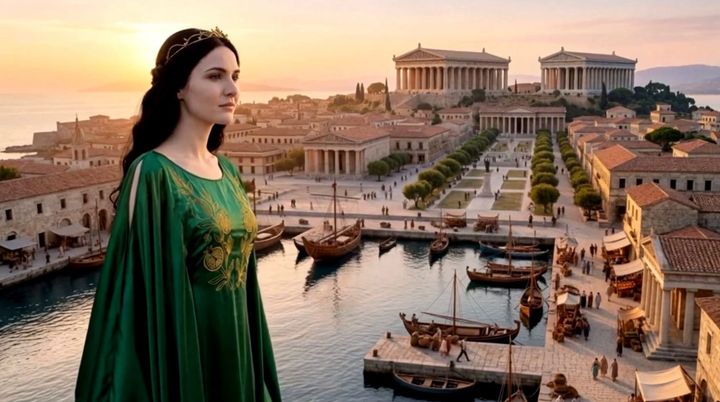
The delegation left early in the morning, poised to reach the shores of Magna Graecia at sunrise.
Everywhere else Persephone was just another goddess of the Pantheon, but in Locri, she was the goddess.
Two majestic temples were raised for her worship, and the city had bestowed upon her the additional honor of being the protector of childbirth, thus managing to intrude upon the attributions of both Hera and Artemis, and therefore offend them both.
Persephone tried to suppress a smile, and figured out if any of the lands of Hellas were going to have the gumption to question the gods, they had to be Locri.
The city had been founded by the Achaeans and was protected by Poseidon; its citizens were aristocratic and never backed down from a fight.
Their sophisticated, unbendable laws, and their appreciation for athletics, culture and the arts, were supported by the enviable wealth of their thriving commerce.
The women of Locri were very special to Persephone, who favored them as much as they did her.
They were independent and powerful, undaunted by their men’s ambitions, and they didn’t indulge the whims and demands of the latter.
They were masters and administrators of their own homes and wealth, acting like earthly goddesses in their own right, and so they didn’t aspire to gain the favor of Aphrodite, and her enchanted binds of desire, or Hera, the ideal obedient wife, or either one of the virgin goddesses, who had to forgo marriage in order to enjoy their freedom.
For the women of Locri, marriage was a life transforming event, as transcendent as the passing into a new life.
Who better to foster their aspirations than the beautiful and adored bride of Hades, goddess of abundance and fertility, ruler of the Elysian Fields and of the Islands of the Blessed?
They felt privileged to be able to bring life into a world where men could only take it, and very aware of the fact those new souls they welcomed to their homes were not new at all: they were all sent by Persephone. It was very important then to curry her favor, she who knew the workings of the Moirae, and who could bring healthy and happy new lives into their homes.
“Don’t let it go to your head, daughter,” her mother curbed her enthusiasm. “I assure you Hera is none too pleased about this, but what are you going to do? The people would choose whom they will.”
The city had prepared extraordinary festivities in her honor, athletic games, theatrical performances, dances, the entire city was filled with the exuberance for life the beginning of summer inspired, an ironic welcome for the goddess of the dead, come to think of it.
“You’re not the goddess of the dead right now,” her mother frowned. “Not while you’re with me, multiplying the fruits of the earth and bringing the blessing of children. If you showed better judgment, you wouldn’t be the goddess of the dead at all,” she couldn’t help herself.
Walking into the splendid celebrations, where she was showered with flowers and seeds and rose petals were thrown at her feet, while new mothers approached her to bless their babies, Persephone knew she would never make the world understand, not even her mother, a goddess in her own right, that there was no separation between the living and the dead, other than the shimmery waters of the Styx, as their souls cycled through the seasons, endlessly, from life to death and back to life again.
And all their lives were made to look brand new, so they’d be eager to live them again, while the Moirae spun their predetermined fates, and charted their paths before they were even born.
If there was a difference at all between the dead and the living, it was in intensity, and not in substance.
The living always feared something: loss, poverty, grief, failing their destinies, and coveted a glut of fleeting vanities which they could never carry to the other side, and when their time came to return to life, the merciful waters of the Lethe made sure they wouldn’t remember that.
She wasn’t the goddess of the dead; she was the goddess of souls, and protector of perennial life on earth, both in her role as harvest bringer and that of under worldly queen.
‘Two thousand new souls!’ she buckled under the weight of such responsibility, wondering how many of the mothers, hers included, had any idea those seagulls that had welcomed their arrival in the harbor weren’t birds at all.
“We praise you, goddess of fertility and patroness of the midwives,” woman after woman came to greet her, bringing amphorae filled with wine and olive oil, loaves of bread and bushels of grain, figs, almonds, grapes and honey, and the most special of all, pomegranates, which had been carefully kept in storage from the year before, especially for this occasion.
The horn of plenty had been spilled at her feet, symbolically, of course, since it was all meant to be consumed in the communal feast set to start in a few hours.
The market by the port was stocked to supply every necessity known to man, from fruit, grains and dried meats and fish, to crockery and metal dishes, all enveloped by the intoxicating scent of exotic spices brought from far away on Achaean ships.
It was bustling with people who looked after their own needs, busy and harried like all the living were, rushing so close to Persephone the latter could barely make her way through the crowd.
“Fix your hair, daughter,” her mother demanded, “wait, no, you’re doing it all wrong! Let me!”
They found a little apse out of the way and Demeter re-braided her daughter’s hair, very pleased with its bounce and shine, and straightened out the crown on her forehead, which was made from the wild flowers of the meadows and brightened up by the fiery red of the poppies.
Her heart leapt with joy just looking at her beautiful daughter, who had kept her girlish figure and countenance even after getting married, and reluctantly condescended Persephone’s life with Hades couldn’t be that bad after all.
She couldn’t imagine what her daughter was doing for half a year, wandering aimlessly through the Asphodel Meadows with absolutely no goals, tasks, or progress.
The memory of asphodels reminded her they were late in visiting the apothecaries, which were Persephone’s favorite part of the trip, one she had been looking forward to since they had arrived.
She could spend hours smelling herbs, checking out jars and testing salves, to the exasperation of her entourage, who would have liked to move on to more satisfying activities.
There was no food involved, other than perhaps the tasting of medicinal honey lozenges, no offerings or praise, just shop talk, for hours and hours, until the mind went numb.
What else could they expect from the queen of the dead? They often wondered whether she counted herself among the living at all, but there was no such thing as dead or alive for the gods, which were, of course, eternal. One had to assume most of them identified with the living, judging by their constant pursuit of ambitions and appetites.
“Well,” her mother interrupted, her face blank after hours of evaluating the quality of dry chamomile and assessing the scent of rosemary bunches.
“Sad as this is, I’m afraid we have to move on. The feast is fast approaching and we haven’t shown our benevolence and blessed the people’s sacrificial offerings.”
‘She does that on purpose,’ Persephone’s mood soured instantly. ‘We couldn’t end one day without blood, could we? Serves me right to be in a good mood.’
“Not if you don’t want to be replaced by Artemis, dear. She always enjoys a good hunt. And she’s good at delivering babies as well, I hear.”
The commentary was meant to poke at Persephone’s pride, since the heavenly twins, Apollo and Artemis, were so popular on mount Olympus, with their good looks and their resplendent confidence, they sucked all the air out of a room and made everyone else, her, mostly, look dull and invisible. Hades didn’t think she was dull and invisible. Hades thought her smile was brighter than all the fires of Tartarus. She missed Hades.
She looked at the beautiful marble statue which represented her and couldn’t help savor the irony of syncretism.
The sculptor who depicted her had taken representative elements from all the other goddesses of Olympus, and from some foreign ones as well, and gave them to Persephone: Hera’s mantle of great matron of Olympus, Artemis’s horned silver crescent, Hestia’s aura of purity and modesty, Aphrodite’s graceful demeanor and languorous beauty, the nubile youthfulness of Hebe.
Most of all, she recognized herself as Isis, proof that the artist had been a worldly man, who enjoyed his travels to far-away lands.
The statue was holding a sistrum, no doubt a gift from the Minoans, probably a thousand years old, which one had to assume had been stolen from Terpsichore.
As if to respond to her inner banter, Apollo slipped past the horizon, to start his nightly travel in a golden cup on the waters of an underground river, Persephone guessed the Acheron.
A giant full moon popped up in the sky to replace him, snubbing the thin horn on Persephone’s brow with perfectly round fullness.
‘I believe many of those seagulls are going to assume their human form tonight,’ she thought. ‘Between the full moon, the dances and carrying jugs of wine up and down stairs, many of my fruitful worshippers will be relieved of their labor.’
It was considered auspicious to give birth during Persephone’s festival, so she let the music take her over and joined in the dances, leaping and swaying under the full moon with the grace and rhythm of the tides.